

To analyze football predictions, start with the evidence, the market, the available odds and the time of the latest update. A useful football preview explains why a result looks plausible, which market fits that view and what could change before kickoff.
Content
- What should a football prediction include?
- How should today's and tomorrow's fixtures be checked?
- How should team form and availability be assessed?
- How do odds change a football prediction?
- Editorial picks, statistics and public opinion
- How Tipsters handles this
- FAQ: Daily football prediction decisions
- Conclusion
For association football, or soccer, Tipsters brings together pre-match analysis, advanced statistics, odds, editorial predictions and user picks. That combination supports a practical research process: identify a fixture, compare the evidence and record a decision with clear conditions.
In brief: Check opponent-adjusted form, player availability, market rules, and the latest odds. Compare editorial analysis with individual user picks and their aggregated distribution in Public Opinion. Review material changes before kickoff.
Football prediction: An evidence-based forecast about a future match outcome or betting market, rather than a statement of certainty.
What should a football prediction include?
A useful football prediction should include the fixture, kickoff timezone, update time, relevant team evidence, selected market and available odds. A useful preview also separates confirmed information from assumptions and identifies what would change the assessment. The strongest format explains the reasoning behind a pick instead of presenting an isolated result.
The minimum evidence for a usable preview
A match winner forecast and a betting recommendation answer different questions. The former concerns the likely result; the latter also depends on the price and market rules. A strong favorite can look likely to win without offering an attractive wager.
- Fixture identity: Competition, home team, away team and kickoff timezone.
- Evidence: Recent performance, opponent strength, venue and availability.
- Market: Match result, goals, handicap or another clearly defined selection.
- Price context: Decimal odds, source and time checked.
- Uncertainty: Pending lineup news or tactical questions.
A prediction describes a possible outcome. A betting assessment must also explain the price and the conditions under which the selection remains relevant.
How should today's and tomorrow's fixtures be checked?
- Confirm today's football fixtures using the competition and kickoff timezone.
- Check recent results and opponent quality.
- Separate confirmed absences from possible lineup changes.
- Record the market and current odds.
- Compare editorial reasoning with user predictions.
- Recheck shortlisted matches when lineups appear, and carry tomorrow's fixtures into a separate review queue.
Check when each prediction was updated
A daily page should distinguish its publication date from the last review of each match. A preview refreshed for team news may still display an older price. Tomorrow's assessment should remain provisional until its own evidence is checked.
Useful update labels identify the event, not just the clock:
- Fixture and timezone verified.
- Availability report reviewed.
- Odds checked for the named market.
- Confirmed starting lineup reviewed.
How should team form and availability be assessed?
- Read football team form against the strength of recent opponents.
- Separate home and away performances where relevant.
- Compare results with chance creation and chances conceded.
- Assess absences by player role and replacement options.
- Check rest, travel and competition priorities.
- Explain how those factors affect the proposed market rather than merely listing them.
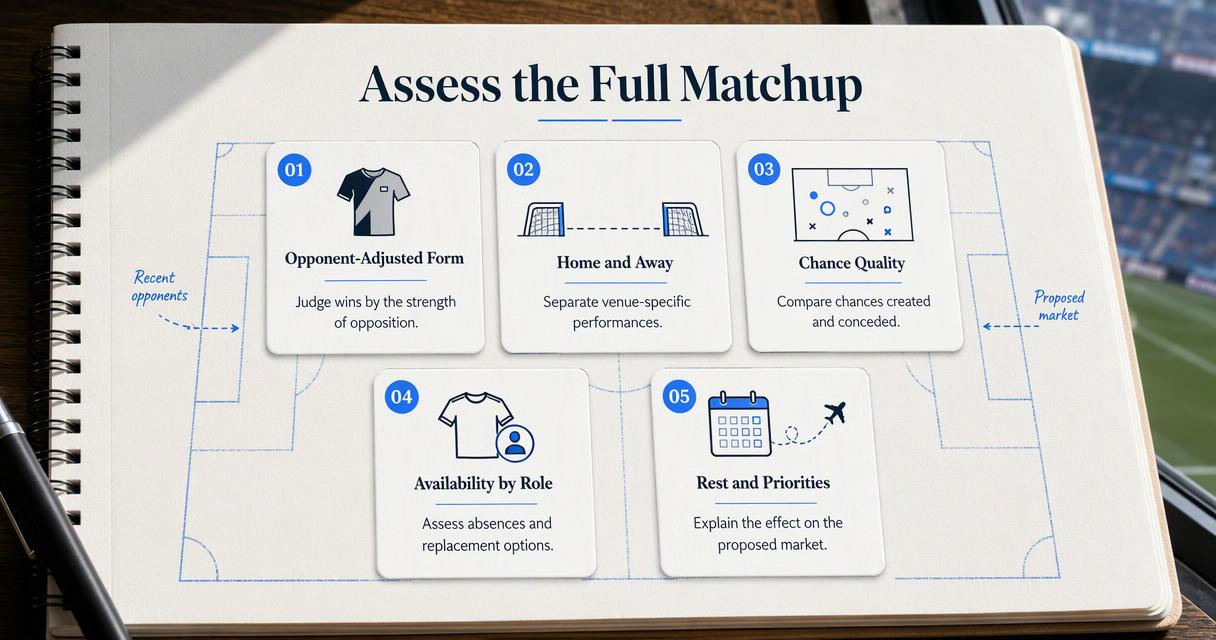
Results need opponent and match context
A winning run is a starting point, not a complete explanation. Narrow victories against weaker opponents can support a different assessment from convincing performances against stronger teams. Red cards, penalties and late goals also affect how much a result says about normal team performance.
When expected goals, often written as xG, are available, they estimate chance quality rather than guarantee future scoring. Different data providers may use different models. Comparisons are clearer when the source and measurement method remain consistent.
The useful question is specific: does the evidence support a home win, a lower goal total or another market? The same form record needn't support every selection.
Player roles matter more than absence counts
Availability analysis should explain what changes on the pitch. A missing ball-progressing midfielder may affect buildup; an absent striker may change pressing or finishing options. Replacement quality and likely formation matter alongside the player's name.
- Confirmed absence: Supported by an identified, current report.
- Doubtful player: Participation remains unresolved.
- Expected lineup: An estimate before official team selection.
- Confirmed lineup: The announced starting team.
Rest and rotation also require context. A crowded schedule creates a question to investigate, not automatic proof that a team will underperform.
How do odds change a football prediction?
Football odds change a prediction's betting relevance because they set the return available for an outcome. Decimal odds can be converted into a raw implied probability by dividing one by the odds. That figure still includes market pricing effects, so it shouldn't be mistaken for an objective forecast or a proven value opportunity.
An illustrative price comparison
The figures below are arithmetic examples, not current match prices, sourced statistics or performance benchmarks. They show why identical football reasoning can lead to different decisions at different odds.
| Hypothetical decimal odds | Raw implied probability | Interpretation |
|---|---|---|
| 1.50 | 66.7% | A relatively high likelihood is priced in |
| 2.00 | 50.0% | The raw implied probability is one-half |
| 3.00 | 33.3% | A less likely outcome can still be considered |
Implied probability: 1 ÷ decimal odds, expressed as a percentage. Across a complete market, raw implied probabilities commonly include a bookmaker margin; they aren't automatically fair probabilities.
Match confidence and price value are separate
A confident selection isn't necessarily good value. Value requires a defensible probability estimate that exceeds the price-implied threshold, with uncertainty considered. Without that estimate, a label such as strong pick describes conviction rather than a measurable advantage.
Market wording matters too. Draw no bet generally returns the stake on a draw, while a standard home-win selection loses on that result. Handicap markets depend on the stated line and settlement rules.
A match preview should name the exact market. Similar-looking selections can have different settlement conditions and different prices.
Editorial picks, statistics and public opinion
Editorial picks, statistical estimates and user predictions offer different perspectives, but they are not necessarily independent evidence. Tipsters Public Opinion summarizes user selections across betting markets rather than providing a separate forecast. Agreement can make a match worth reviewing, but it doesn't establish independent confirmation when the same information drives multiple views.
What each prediction signal can explain
Each signal earns its place through transparency about its inputs and reasoning.
| Signal | Main contribution | Useful check |
|---|---|---|
| Editorial prediction | Interprets tactics, team news and match context | Is the reasoning current and market-specific? |
| Statistical estimate | Summarizes patterns through a stated method | Are inputs and evaluation methods explained? |
| User predictions & Public Opinion | Individual picks and their aggregate distribution across markets | Are the sample size, market and source of sentiment clear? |
| Market movement | Shows changes in available prices | Were the same market and source compared? |
A percentage of user picks isn't automatically a team's probability of winning. Nor does a popular selection become wrong simply because it is popular. Sentiment is context that requires interpretation.
How Tipsters handles this
Tipsters combines pre-match context, advanced statistics, odds, editorial predictions, user picks, market trends and public opinion in one platform. Its today and tomorrow match listings support research across soccer, ice hockey and basketball, while educational articles explain odds formats and common betting markets.
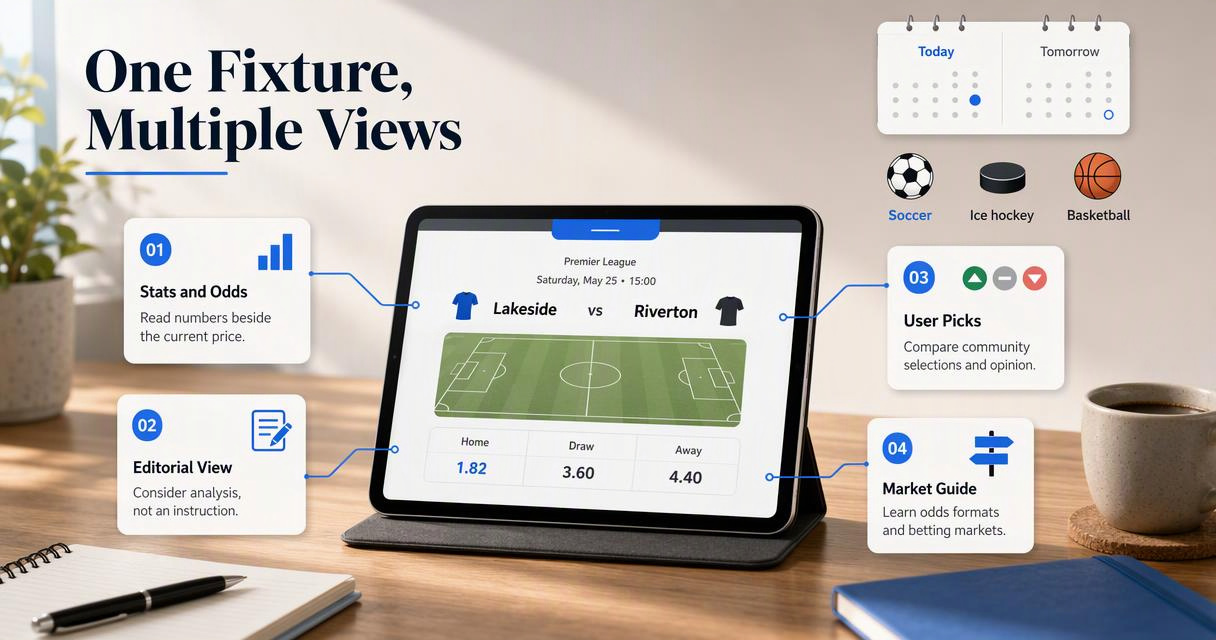
A practical football research workflow
For football followers, the useful distinction is the combination of evidence types around an upcoming fixture. An editorial view can be read alongside statistics and community selections rather than treated as a standalone instruction.
- Select a match from today's or tomorrow's listings.
- Read the pre-match analysis and available statistics.
- Examine the odds for the specific market under consideration.
- Compare editorial reasoning with individual user predictions and their aggregated distribution in Public Opinion.
- Consult educational material when a market's rules need clarification.
Who benefits most: Readers seeking context before selecting a bet, and prediction-focused fans comparing professional analysis with community views. Tipsters provides match analysis, statistics, odds and predictions for free. Users can also submit their own predictions without registration. Tipsters is an analysis and prediction service, not a bookmaker, and does not accept wagers.
FAQ: Daily football prediction decisions
Daily football prediction decisions are easier to evaluate when the meaning of confidence, timing and market choice is clear. These answers address common questions without treating any forecast as a guaranteed result.
Are free football predictions reliable?
Free football predictions should be judged by their reasoning, freshness and documented evaluation, not their price. A useful preview identifies the market, evidence and uncertainty. A claimed track record needs enough detail to assess the selections and prices involved. Free access alone neither proves nor disproves forecasting quality.
When should a pre-match prediction be reviewed?
A pre-match prediction should be reviewed when information relevant to its reasoning changes, particularly confirmed lineups, player availability or the offered price. The earlier preview can remain useful as background. The final assessment should identify which assumptions still hold and whether the selected market still matches the evidence.
Are accumulators better than single bets?
Accumulators combine selections and usually require every leg to succeed, subject to the operator's rules. They offer a larger potential return but add ways for the overall ticket to lose. Single bets make each selection easier to evaluate separately. A larger payout doesn't demonstrate that the combined selections offer better value.
What should happen when evidence is incomplete?
Incomplete evidence should produce a qualified assessment or a decision to wait, rather than an invented confidence score. A preview can name the missing information and explain how it affects the market. For betting activity, adults should follow local laws, use affordable limits and avoid treating predictions as income.
Conclusion
Analyzing football predictions works best as a repeatable process: verify the fixture, explain the evidence, compare the price and record the next review trigger.
For readers ready to apply that process, Tipsters offers a combined view of match analysis, statistics and predictions. Visit tipsters.net, select one upcoming football fixture and build a timestamped assessment before moving to the next match.





No Comments